How to determine vehicle's OBD2 protocol.
To determine what protocol your vehicle uses, check for a label under the hood or check your vehicle's diagnostic connector.
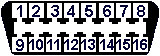
- J1850 PWM - The connector must have pins 2, 4, 5, 10, and 16. May or may not have additional pins.
- J1850 VPW - The connector must have pins 2, 4, 5, and 16, but not 10. May or may not have additional pins.
- ISO 9141-2 & KPW - The connector must have pins 4, 5, 7, and 16. Pin 15 may or may not be present.
- CAN-BUS (J1939 & ISO15765-4) - This type of connector must have pins 6 and 14.
|
What is CAN-BUS?
Controller–area network (CAN or CAN-bus) is a vehicle bus standard designed to allow microcontrollers and devices to communicate with each other within a vehicle without a host computer.
A modern automobile may have as many as 50 (the Mercedes S-class has about 60 onboard computers) electronic control units (ECU) for various subsystems[citation needed]. Typically the biggest processor is the engine control unit, which is also referred to as "ECU" in the context of automobiles; others are used for transmission, airbags, antilock braking, cruise control, audio systems, windows, doors, mirror adjustment, etc. Some of these form independent subsystems, but communications among others are essential. A subsystem may need to control actuators or receive feedback from sensors. The CAN standard was devised to fill this need.
CAN is used in the OBD-II vehicle diagnostics standard, mandatory for all cars and light trucks sold in the United States since 1996, and the EOBD standard, mandatory for all petrol vehicles sold in the European Union since 2001 and all diesel vehicles since 2004.
Pinouts for common CAN-bus connectors
|
Helpful links
|
Helpful links
| Interface type |
Common compatible vehicles |
Compatible protocols |
| ELM320 Serial |
Ford, Mazda, Mercury |
J1850 PWM |
| ELM322 Serial |
GM, Buick, Cadillac, Chevy, Dodge, GMC, Isuzu, Jeep, Oldsmobile, Pontiac, Saturn, Toyota |
J1850 VPW |
ELM323 USB
ELM323 Serial |
Audi, BMW, Chrysler, Citroen, Dodge, Fiat, Geo, Honda, Hyundai, Jeep, Kia, Land Rover, Mazda, Mercedes, Benz, Mini, Mitsubishi, Nissan, Opel, Peugeot, Renault, Saab, Subaru, Suzuki, Toyota, VW, Volvo |
ISO9141
ISO14230
KWP 2000 |
ELM327 USB
ELM327 Serial
ELM327 Bluetooth |
All above vehicles plus CAN-bus enabled vehicles |
1850PWM
J1850VPW
ISO9141
ISO14230
KWP 2000
J1939
ISO15765-4 |
|
|
 |
Features
- Read Codes: Display all Trouble Codes and Descriptions. Poll some codes more frequently than others. View minimum, maximum, & current values
- Export Data for spreadsheet & printing
- Clear Codes: Arrange, add, delete codes to your specifications
- Monitor real time data in Metric & U.S. Standard
- Record & Graph data
- Performance Timer: 0 to 100 km/h
- Many advanced features
|
Compatibility
- Some compatible vehicles include: Ford, Chevrolet, Chrysler, Acura, BMW, Buick, Cadillac, Daewoo, Dodge, Fiat, GMC, Honda, Hyundai, Infinity, Isuzu, Jaguar, Jeep, Kia, Land Rover, Lexus, Mazda, Mercedes-Benz, Mercury, Mini, Mitsubishi, Nissan, Oldsmobile, Peugeot, Pontiac, Porsche, Renault, Saab, Saturn, Seat, Skoda, Smart, Suzuki, Toyota, Volkswagen, Audi, Volvo, and many others.
- Supported OBDII protocols: ISO9141, ISO14230 (KWP 2000)
- Compatible software (free):
|
Specifications
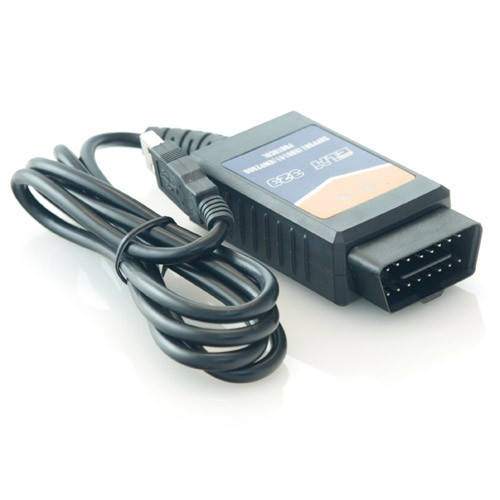
- Includes 16 Pin Connector with Interface (Elm chip included) & USB Port Cable
- Elm Chip installed
- Connects to your computers USB Port
- Compatible with ISO9141, ISO14230 (KWP 2000) Protocols
- LED Status lights
- Powered from vehicle's OBD2 connector
- Can be used on Palm OS, Unix, Pocket PC
|
Package content
|
|
|
|
|